Java Recursion
Updated 8 min read Aimerscrew
Some problems are naturally made of smaller copies of themselves. A folder contains folders, which contain more folders. The factorial of 5 is 5 times the factorial of 4. Java recursion lets a method solve a problem like this by calling itself on a smaller piece. In this lesson, you'll learn the two parts every recursive method needs, watch the call stack grow and shrink, write classic examples like factorial and Fibonacci, and learn when a plain loop is the better choice.
🌍 Real-life example
You're in a dark cinema and want to know your row number. You ask the person in front of you, "What row are you in?" They don't know either, so they ask the person in front of them, and so on. The person in the front row knows the answer: "Row 1!" (that's the base case). Each person then adds 1 and passes the answer back. That's recursion: the same question passed along, a simple case that stops it, and answers flowing back.
What is recursion in Java?
Recursion is a technique where a method calls itself. A method that does this is called a recursive method. Every correct recursive method has two parts:
- A base case: a simple situation where the method returns an answer directly, without calling itself. This is what stops the recursion.
- A recursive case: the method calls itself with a smaller or simpler input, moving one step closer to the base case.
Here's a rocket launch countdown written recursively:
public class Launch {
    public static void main(String[] args) {
        countdown(5);
    }

    public static void countdown(int seconds) {
        if (seconds == 0) {                 // base case
            System.out.println("Liftoff!");
            return;
        }
        System.out.println(seconds + "...");
        countdown(seconds - 1);             // recursive case: a smaller problem
    }
}
5...
4...
3...
2...
1...
Liftoff!Each call prints one number and hands the rest of the countdown to a new call with one second less. When seconds reaches 0, the base case prints "Liftoff!" and the calls stop.
How does recursion work? The call stack
As you learned in Java variable scope, every method call gets its own stack frame with its own parameters and local variables. Recursion is no different: each call to the same method gets a separate frame, with its own copy of n. Let's use the classic example, the factorial. The factorial of n, written n!, is n × (n-1) × ... × 1. So 4! = 4 × 3 × 2 × 1 = 24. Notice that 4! = 4 × 3!: a smaller copy of the same problem.
public class Factorial {
    public static void main(String[] args) {
        System.out.println("4! = " + factorial(4));
        System.out.println("10! = " + factorial(10));
    }

    public static long factorial(int n) {
        if (n <= 1) {                       // base case
            return 1;
        }
        return n * factorial(n - 1);        // recursive case
    }
}
4! = 24
10! = 3628800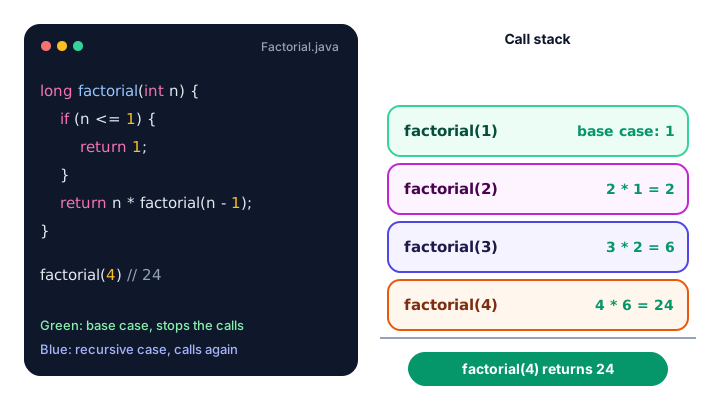
There are two phases:
- Winding:
factorial(4)can't finish until it knowsfactorial(3), which waits forfactorial(2), which waits forfactorial(1). Four frames now sit on the stack. - Unwinding:
factorial(1)returns 1. Thenfactorial(2)returns2 × 1 = 2,factorial(3)returns3 × 2 = 6, and finallyfactorial(4)returns4 × 6 = 24.
We used long as the return type because factorials grow very fast; 13! is already too big for an int.
How do you write a recursive method?
Ask yourself three questions:
- What's the simplest version of the problem? That's your base case (for example, a number with one digit, an empty string,
n == 0). - How can I make the problem a bit smaller? (Remove one digit, one character, subtract 1.)
- If I trust the method to solve the smaller problem, how do I use that answer?
Let's apply this to adding up the digits of a number, like 4096 → 4 + 0 + 9 + 6 = 19. The simplest case is a single digit (less than 10): its sum is itself. To make the problem smaller, chop off the last digit with / 10; the last digit itself is % 10.
public class DigitSum {
    public static void main(String[] args) {
        System.out.println(sumDigits(4096));
        System.out.println(sumDigits(7));
        System.out.println(sumDigits(123456789));
    }

    public static int sumDigits(int number) {
        if (number < 10) {                                // base case: one digit
            return number;
        }
        return number % 10 + sumDigits(number / 10);      // last digit + sum of the rest
    }
}
19
7
45The same recipe works for text. A word is a palindrome if it reads the same backwards, like "level". An empty or one-letter string is always a palindrome (base case). Otherwise, the first and last letters must match, and the middle must be a palindrome too:
public class Palindrome {
    public static void main(String[] args) {
        System.out.println(isPalindrome("level"));
        System.out.println(isPalindrome("racecar"));
        System.out.println(isPalindrome("rocket"));
    }

    public static boolean isPalindrome(String word) {
        if (word.length() <= 1) {
            return true;
        }
        if (word.charAt(0) != word.charAt(word.length() - 1)) {
            return false;
        }
        return isPalindrome(word.substring(1, word.length() - 1));
    }
}
true
true
falseFibonacci with recursion (and why it's slow)
The Fibonacci sequence starts 0, 1, and each next number is the sum of the two before it: 0, 1, 1, 2, 3, 5, 8, 13... The definition is itself recursive: fib(n) = fib(n-1) + fib(n-2), with fib(0) = 0 and fib(1) = 1 as base cases. It translates almost word for word into Java:
public class Fibonacci {
    public static void main(String[] args) {
        for (int n = 0; n <= 10; n++) {
            System.out.print(fib(n) + " ");
        }
        System.out.println();
    }

    public static long fib(int n) {
        if (n <= 1) {
            return n;                        // fib(0) = 0, fib(1) = 1
        }
        return fib(n - 1) + fib(n - 2);
    }
}
0 1 1 2 3 5 8 13 21 34 55 It looks elegant, but there's a hidden problem. Each call makes two more calls, and the same values get recalculated again and again: fib(5) computes fib(3) twice, fib(2) three times, and so on. Let's count the calls with a counter stored in a field (a variable outside the methods, which you met briefly in the scope lesson):
public class FibonacciCalls {
    static long calls = 0;

    public static void main(String[] args) {
        int[] tests = {10, 20, 30};
        for (int n : tests) {
            calls = 0;
            long result = fib(n);
            System.out.println("fib(" + n + ") = " + result + " took " + calls + " calls");
        }
    }

    public static long fib(int n) {
        calls++;
        if (n <= 1) {
            return n;
        }
        return fib(n - 1) + fib(n - 2);
    }
}
fib(10) = 55 took 177 calls
fib(20) = 6765 took 21891 calls
fib(30) = 832040 took 2692537 callsAlmost 2.7 million calls for fib(30)! The number of calls roughly doubles each time n grows, so fib(50) would need about 40 billion calls. A simple loop that remembers the last two values needs only n steps:
public class FibonacciLoop {
    public static void main(String[] args) {
        System.out.println(fib(50));
    }

    public static long fib(int n) {
        long previous = 0;
        long current = 1;
        if (n == 0) {
            return 0;
        }
        for (int i = 2; i <= n; i++) {
            long next = previous + current;
            previous = current;
            current = next;
        }
        return current;
    }
}12586269025This prints instantly. The lesson: a recursive solution can be correct but very slow if it repeats work.
What causes a StackOverflowError?
The call stack has a limited size. If a recursive method never reaches its base case, it keeps pushing frames until the stack is full, and Java stops the program with a StackOverflowError. Here's a countdown with the base case forgotten:
public static void countdown(int n) {
    System.out.println(n);
    countdown(n - 1);    // no base case: never stops
}
It prints thousands of numbers (3, 2, 1, 0, -1, -2...) and then crashes with:
Exception in thread "main" java.lang.StackOverflowErrorThe same thing happens if the base case exists but can't be reached. For example, if (n == 0) with a recursive call on n - 2 never stops for an odd starting number, because n jumps from 1 to -1 and skips 0. A safer base case is if (n <= 0).
⚠️ Deep recursion
Even correct recursion can overflow if it goes too deep. Summing the numbers 1 to 1,000,000 with one recursive call per number would need a million frames, which is more than the default stack allows. For long, simple repetition, use a loop.
Recursion vs loops: which should you use?
Anything you can do with recursion, you can also do with a loop (and vice versa). The choice is about clarity and cost:
| Recursion | Loop (iteration) | |
|---|---|---|
| How it repeats | The method calls itself | for / while repeats a block |
| How it stops | Base case | Loop condition becomes false |
| Memory | One stack frame per call | Same few variables reused |
| Risk | StackOverflowError if too deep | Infinite loop if the condition never fails |
| Best for | Problems shaped like trees or nested structures: folders, family trees, mazes, divide-and-conquer sorting | Simple counting and walking through arrays or lists |
💡 Tip
When writing a recursive method, write the base case first. Then check that every recursive call moves closer to it. If you can't explain why the input gets "smaller" each time, the recursion probably won't stop.
Common mistakes with recursion
1. No base case
Without one, the method calls itself forever until the stack overflows.
2. A base case that's never reached
Check that the input actually moves toward the base case. countdown(n + 1) instead of countdown(n - 1) heads the wrong way.
3. Forgetting to return the recursive result
public static long factorial(int n) {
    if (n <= 1) {
        return 1;
    }
    factorial(n - 1);      // result thrown away
    return n;              // wrong answer
}
The recursive call's result must be used: return n * factorial(n - 1);.
4. Using recursion where it repeats work
Like the naive Fibonacci, some recursive designs recalculate the same answers over and over. If a recursive method is mysteriously slow, count the calls.
Practice exercise
🏋️ Try it yourself
Write a recursive method long power(int base, int exponent) that calculates base to the power of exponent (for exponents 0 and above) without using loops or Math.pow. Hint: anything to the power of 0 is 1, and basee = base × basee-1. Test it with 210, 53 and 70.
Show solution
public class Power {
    public static void main(String[] args) {
        System.out.println(power(2, 10));
        System.out.println(power(5, 3));
        System.out.println(power(7, 0));
    }

    public static long power(int base, int exponent) {
        if (exponent == 0) {
            return 1;
        }
        return base * power(base, exponent - 1);
    }
}
1024
125
1What's next?
You've written your own calculations, from tips to factorials. Java also ships with a ready-made toolbox for math: square roots, powers, rounding and more. Explore it in the Java Math class.
Key takeaways
- Recursion is when a method calls itself to solve a smaller version of the same problem.
- Every recursive method needs a base case that stops the calls and a recursive case that moves toward it.
- Each recursive call gets its own stack frame with its own copies of parameters and local variables.
- Recursion winds up until the base case, then unwinds as each call returns its result.
- Naive recursive Fibonacci repeats work and needs millions of calls; a loop is far faster.
- A missing or unreachable base case fills the stack and causes a StackOverflowError.
- Use recursion for tree-like or nested problems and loops for simple repetition.
Frequently asked questions
What is recursion in Java?
Recursion is a technique where a method calls itself with a smaller or simpler input. It keeps doing so until it reaches a base case that can be answered directly.
What is a base case in recursion?
The base case is the condition under which a recursive method returns a result without calling itself again. It stops the recursion; without it the method would call itself forever.
What causes java.lang.StackOverflowError?
It happens when too many method calls are waiting on the call stack at once, most often because a recursive method has no base case or never reaches it.
Is recursion faster than a loop in Java?
Usually not. Each recursive call costs a stack frame, and some recursive designs repeat work. Loops are typically faster and use less memory, while recursion can be clearer for nested, tree-like problems.
Can every recursive method be written with a loop?
Yes. Any recursion can be rewritten using loops, sometimes with your own stack data structure to remember pending work. For simple cases like factorial, a plain loop is easy.