Python Recursion
Updated 7 min read Aimerscrew
Most functions you've written so far call other functions, like print() or len(). But a function can also call itself. That's Python recursion: solving a big problem by breaking it into a smaller copy of the same problem, again and again, until it becomes trivially easy. In this lesson, you'll learn the two parts every recursive function needs, watch the call stack grow and shrink, and see when a plain loop is the better choice.
🌍 Real-life example
Think of Russian nesting dolls. To find the tiniest doll, you open the big doll and find a smaller doll inside. You do the same thing to that one, and again, until you reach a doll that doesn't open. That solid little doll is where you stop. Folders on your computer work the same way: a folder can contain files and more folders, which can contain more folders. To count every file, you look inside each folder and repeat the same steps for every folder you find.
What is recursion in Python?
A recursive function is a function that calls itself. Each call works on a smaller or simpler input than the one before, until the input is so small that the answer is obvious.
def countdown(n):
    if n == 0:
        print("Liftoff!")
        return
    print(n)
    countdown(n - 1)

countdown(3)
3
2
1
Liftoff!countdown(3) prints 3 and calls countdown(2), which prints 2 and calls countdown(1), and so on. When n reaches 0, the function prints "Liftoff!" and stops calling itself.
Base case and recursive case
Every recursive function has two parts:
- Base case – the condition where the function stops and returns an answer directly, without calling itself. In
countdown(), it'sn == 0. This is the doll that doesn't open. - Recursive case – the part where the function calls itself with a smaller input, moving one step closer to the base case. In
countdown(), it'scountdown(n - 1).
⚠️ Be careful
If the base case is missing, or the input never gets closer to it, the function keeps calling itself forever. Python stops it with a RecursionError, which you'll see later in this lesson.
How to calculate a factorial with recursion
The factorial of a number (written n!) is that number multiplied by every whole number below it, down to 1. For example, 4! = 4 × 3 × 2 × 1 = 24. Notice that 4! is just 4 × 3!. That "same problem, but smaller" shape is perfect for recursion:
def factorial(n):
    if n == 1:                       # base case
        return 1
    return n * factorial(n - 1)      # recursive case

print(factorial(3))
print(factorial(5))
6
120How does the call stack work in recursion?
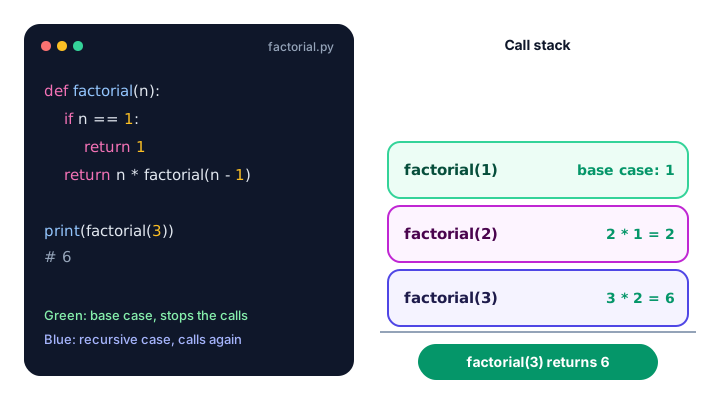
Python keeps track of running functions on the call stack, a pile of "frames" where each frame remembers one function call and its local variables. A new call is placed on top. When a call returns, its frame is removed and Python goes back to the frame underneath.
Here's what happens for factorial(3):
factorial(3)needs3 * factorial(2), so it waits and callsfactorial(2).factorial(2)needs2 * factorial(1), so it waits and callsfactorial(1).factorial(1)hits the base case and returns1. The stack stops growing.factorial(2)gets the 1 back, calculates2 * 1 = 2and returns 2.factorial(3)gets the 2 back, calculates3 * 2 = 6and returns 6.
You can see this order for yourself by adding print() calls:
def factorial(n):
    print(f"Calling factorial({n})")
    if n == 1:
        return 1
    result = n * factorial(n - 1)
    print(f"factorial({n}) returns {result}")
    return result

factorial(3)
Calling factorial(3)
Calling factorial(2)
Calling factorial(1)
factorial(2) returns 2
factorial(3) returns 6All the "Calling" lines come first (the stack grows), then the "returns" lines appear in reverse order (the stack shrinks).
Summing a list with recursion
The total of a list is its first item plus the total of the rest of the list. The base case is an empty list, whose total is 0. This uses list slicing: prices[1:] is every item except the first.
def cart_total(prices):
    if not prices:                   # base case: empty list
        return 0
    return prices[0] + cart_total(prices[1:])

print(cart_total([12, 5, 8, 20]))45Each call works on a list that is one item shorter, so it's guaranteed to reach the empty list eventually.
Real-world example: counting files in nested folders
Recursion really shines when data is nested inside data of the same shape, like folders inside folders. Here, each folder is a dictionary with a number of files and a list of subfolders:
photos = {
    "files": 2,
    "subfolders": [
        {"files": 5, "subfolders": []},
        {"files": 1, "subfolders": [
            {"files": 3, "subfolders": []},
        ]},
    ],
}

def count_files(folder):
    total = folder["files"]
    for sub in folder["subfolders"]:
        total += count_files(sub)    # same job, smaller folder
    return total

print("Total files:", count_files(photos))
Total files: 11The function doesn't need to know how deep the folders go. A folder with no subfolders is the base case: the loop doesn't run, so it simply returns its own file count.
What is the recursion limit in Python?
Every waiting call takes up memory on the call stack, so Python sets a limit on how deep recursion can go. By default it's 1,000 calls. You can check it with the sys module (you'll learn about imports in Python modules):
import sys
print(sys.getrecursionlimit())1000If a function goes deeper than that, usually because the base case is missing, Python raises a RecursionError:
def countdown(n):
    print(n)
    countdown(n - 1)     # no base case!

countdown(3)
RecursionError: maximum recursion depth exceededYou'll see 3, 2, 1, 0, -1, -2 and hundreds more numbers printed before the error. The fix is to add a base case, not to raise the limit.
Recursion vs loop: which should you use?
Anything you can do with recursion, you can also do with a loop. Here's factorial with a for loop:
def factorial_loop(n):
    result = 1
    for number in range(2, n + 1):
        result *= number
    return result

print(factorial_loop(5))120| Recursion | Loop | |
|---|---|---|
| How it repeats | The function calls itself | for or while repeats a block |
| How it stops | Base case | Loop condition or end of the sequence |
| Memory | One stack frame per call | Uses the same variables each time |
| Depth limit | About 1,000 calls by default | No limit |
| Best for | Nested data: folders, family trees, menus inside menus | Simple repetition: counting, totals, going through a list |
💡 Tip
A good rule of thumb: if the data is flat (a list of prices), use a loop. If the data is nested and you don't know how deep it goes (folders inside folders), recursion is often the clearest solution.
Common mistakes with recursion
1. Forgetting the base case
Without a stopping condition, you get RecursionError. Always write the base case first.
2. Not moving toward the base case
If countdown(n) checks n == 0 but calls countdown(n - 2), then countdown(3) jumps from 1 to -1 and skips 0 forever. A safer base case is if n <= 0:.
3. Forgetting to return the recursive result
def factorial(n):
    if n == 1:
        return 1
    n * factorial(n - 1)     # calculated, but not returned

print(factorial(3))
TypeError: unsupported operand type(s) for *: 'int' and 'NoneType'Without return, factorial(2) gives back None, and 3 * None fails. Write return n * factorial(n - 1).
Practice exercise
🏋️ Try it yourself
Write a recursive function reverse_text(text) that returns the text backwards. Hint: the reverse of a string is the reverse of everything after the first character, followed by the first character. The base case is an empty string. Test it with "stressed".
Show solution
def reverse_text(text):
    if text == "":
        return ""
    return reverse_text(text[1:]) + text[0]

print(reverse_text("stressed"))dessertsWhat's next?
You've seen how functions can call themselves. To finish the chapter, explore the handy tools Python gives you for free in useful Python built-in functions like map(), filter(), zip() and enumerate().
Key takeaways
- Recursion is when a function calls itself to solve a smaller version of the same problem.
- Every recursive function needs a base case that stops the calls and a recursive case that moves toward it.
- Python keeps each waiting call on the call stack; the stack grows as calls are made and shrinks as they return.
- Python limits recursion depth to about 1,000 calls and raises RecursionError beyond that.
- Always return the result of the recursive call, or the caller receives None.
- Use loops for flat, simple repetition and recursion for nested data like folders inside folders.
Frequently asked questions
What is recursion in Python?
Recursion is a technique where a function calls itself with a smaller input until it reaches a simple case it can answer directly. A classic example is factorial, where factorial(n) returns n * factorial(n - 1).
What is a base case in recursion?
The base case is the condition where a recursive function stops calling itself and returns an answer directly, such as returning 1 when n is 1 in a factorial function. Without it, the function never stops.
What causes RecursionError in Python?
RecursionError: maximum recursion depth exceeded happens when a function calls itself more than about 1,000 times without returning, usually because the base case is missing or never reached.
What is the maximum recursion depth in Python?
The default limit is 1,000 nested calls. You can check it with sys.getrecursionlimit(). It can be changed with sys.setrecursionlimit(), but fixing the base case or using a loop is usually the better solution.
Is recursion better than a loop in Python?
Not in general. Loops use less memory and have no depth limit, so they are better for simple repetition. Recursion is clearer for nested structures like folder trees, menus or JSON data.