Recursion in C
Updated 8 min read Aimerscrew
Some problems contain smaller copies of themselves. Recursion in C is a technique where a function solves a problem by calling itself on a smaller piece of it, until the piece is so small the answer is obvious. In this lesson, you'll write recursive functions for countdowns, factorials, digit sums and Fibonacci numbers, see how the call stack grows and shrinks, and learn when a plain loop is the better choice.
🌍 Real-life example
Open a set of Russian nesting dolls. Each doll contains a smaller doll, so you repeat the same action, "open the doll", again and again. You stop when you reach the tiny solid doll that doesn't open. That tiny doll is the base case. Folders on your computer work the same way: to count all files in a folder, you count its files and then count the files in each subfolder using the very same method.
What is recursion in C?
A recursive function is a function that calls itself. Every working recursive function has two parts:
- Base case: the simplest input, answered directly without another call. This is what stops the recursion.
- Recursive case: the function calls itself with a smaller input, moving one step closer to the base case.
Here's a rocket countdown. The base case is n == 0; the recursive case prints n and counts down from n - 1.
#include <stdio.h>

void countdown(int n) {
    if (n == 0) {                 /* base case */
        printf("Liftoff!\n");
        return;
    }
    printf("%d\n", n);
    countdown(n - 1);             /* recursive case */
}

int main(void) {
    countdown(3);
    return 0;
}
3
2
1
Liftoff!Factorial: the classic recursion example
The factorial of n (written n!) is n × (n-1) × ... × 1. For example, 4! = 4 × 3 × 2 × 1 = 24. Notice that 4! = 4 × 3!. A factorial contains a smaller factorial, which makes it a natural fit for recursion:
#include <stdio.h>

int factorial(int n) {
    if (n <= 1) {
        return 1;                     /* base case: 0! and 1! are 1 */
    }
    return n * factorial(n - 1);      /* recursive case */
}

int main(void) {
    for (int i = 0; i <= 5; i++) {
        printf("%d! = %d\n", i, factorial(i));
    }
    return 0;
}
0! = 1
1! = 1
2! = 2
3! = 6
4! = 24
5! = 120⚠️ Factorials grow fast
An int on most systems can only hold 12! (479,001,600). 13! overflows it. Use long long with %lld for values up to 20!.
How does recursion work? The call stack
Every time a function is called, C sets aside a small chunk of memory called a stack frame. It holds that call's parameters and local variables (remember from variable scope that each call gets its own fresh locals). Frames are piled up on the call stack: a new call goes on top, and when a call returns, its frame is removed.
So factorial(3) can't finish until factorial(2) gives it an answer, and factorial(2) waits for factorial(1). The stack grows until the base case, then shrinks as each waiting call multiplies and returns.
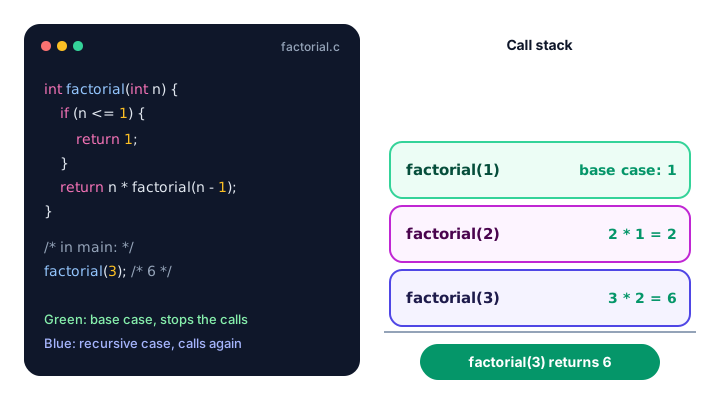
You can watch this happen by adding a few printf calls:
#include <stdio.h>

int factorial(int n) {
    printf("Calling factorial(%d)\n", n);
    if (n <= 1) {
        printf("Base case reached, returning 1\n");
        return 1;
    }
    int result = n * factorial(n - 1);
    printf("factorial(%d) returns %d\n", n, result);
    return result;
}

int main(void) {
    printf("Answer: %d\n", factorial(3));
    return 0;
}
Calling factorial(3)
Calling factorial(2)
Calling factorial(1)
Base case reached, returning 1
factorial(2) returns 2
factorial(3) returns 6
Answer: 6The "Calling" lines appear on the way down, and the "returns" lines appear in reverse order on the way back up. Answer: 6 is printed last because printf needs the finished result before it can print anything.
Sum of digits with recursion
Recursion is handy whenever you can peel off one piece and repeat. To add the digits of a number, take the last digit with n % 10, and add the digit sum of the rest, n / 10. A single-digit number is the base case.
#include <stdio.h>

int sum_digits(int n) {
    if (n < 10) {
        return n;
    }
    return n % 10 + sum_digits(n / 10);
}

int main(void) {
    printf("Sum of digits of 4096 is %d\n", sum_digits(4096));
    return 0;
}
Sum of digits of 4096 is 19The calls go 4096 → 409 → 40 → 4, then add up on the way back: 4 + 0 + 9 + 6 = 19.
Fibonacci: why the simple version is slow
In the Fibonacci sequence, each number is the sum of the two before it: 0, 1, 1, 2, 3, 5, 8, ... The definition is recursive, so the code looks almost exactly like the math:
#include <stdio.h>

int fib(int n) {
    if (n <= 1) {
        return n;                        /* fib(0) = 0, fib(1) = 1 */
    }
    return fib(n - 1) + fib(n - 2);
}

int main(void) {
    for (int i = 0; i < 10; i++) {
        printf("%d", fib(i));
        if (i < 9) {
            printf(", ");
        }
    }
    printf("\n");
    return 0;
}
0, 1, 1, 2, 3, 5, 8, 13, 21, 34It's correct, but it does a huge amount of repeated work. fib(5) calls fib(4) and fib(3), but fib(4) also calls fib(3), and so on. The number of calls roughly doubles each time n grows. Let's count them with a global counter:
#include <stdio.h>

int calls = 0;

int fib(int n) {
    calls++;
    if (n <= 1) {
        return n;
    }
    return fib(n - 1) + fib(n - 2);
}

int main(void) {
    int answer = fib(20);
    printf("fib(20) = %d\n", answer);
    printf("Function calls: %d\n", calls);
    return 0;
}
fib(20) = 6765
Function calls: 21891Almost 22,000 calls for one small answer! fib(40) would need over 300 million. A loop that remembers just the last two numbers needs only 40 steps:
#include <stdio.h>

int fib_loop(int n) {
    int a = 0;
    int b = 1;
    for (int i = 0; i < n; i++) {
        int next = a + b;
        a = b;
        b = next;
    }
    return a;
}

int main(void) {
    printf("fib(20) = %d\n", fib_loop(20));
    printf("fib(40) = %d\n", fib_loop(40));
    return 0;
}
fib(20) = 6765
fib(40) = 102334155What happens without a base case? Stack overflow
If a recursive function never reaches a base case, it keeps calling itself, and every call adds another frame to the call stack.
void forever(int n) {
    forever(n + 1);   /* no base case: never stops */
}
The call stack is small (often around 1 to 8 MB). After many thousands of calls it runs out of room. This is called a stack overflow, and the program crashes, usually with a message like Segmentation fault on Linux and macOS, or simply exits with an error code on Windows. The same happens if the recursive case doesn't move toward the base case, for example calling countdown(n + 1) instead of countdown(n - 1).
Recursion vs loops: which should you use?
Anything you can do with recursion, you can also do with a loop, and vice versa. Choose the one that makes the code clearer and safe.
| Recursion | Loop | |
|---|---|---|
| How it repeats | Function calls itself | for / while runs the body again |
| How it stops | Base case | Loop condition becomes false |
| Memory | One stack frame per call | Same variables reused |
| Speed | Slightly slower (call overhead) | Usually faster |
| Risk | Stack overflow if too deep | Infinite loop if the condition never changes |
| Best for | Nested shapes: folders, trees, divide-and-conquer | Simple counting and going through items one by one |
💡 Tip
For simple counting problems like factorial, a loop is usually the practical choice in C. Recursion shines when the data itself is nested, which you'll see later with sorting algorithms and binary search. If you know Python, compare with recursion in Python: the idea is identical.
Common mistakes
1. Forgetting the base case
Without a base case, the function calls itself until the stack overflows and the program crashes. Write the base case first, before the recursive call.
2. Not making the problem smaller
return n * factorial(n); calls itself with the same value forever. Each call must move toward the base case: factorial(n - 1).
3. A base case that can be skipped
With if (n == 1) as the only base case, calling factorial(0) goes to -1, -2, ... and never stops. Using n <= 1 catches 0 and negative numbers too.
4. Forgetting to return the recursive result
int factorial(int n) {
    if (n <= 1) {
        return 1;
    }
    n * factorial(n - 1);   /* result thrown away: no return */
}
GCC warns that control reaches the end of a non-void function, and the caller gets a garbage value. Always write return in front of the recursive expression.
Practice exercise
🏋️ Try it yourself
Write a recursive function int power(int base, int exponent) that calculates base raised to exponent (for exponent 0 or more) without using a loop. Hint: anything to the power 0 is 1, and base^exponent = base × base^(exponent - 1). Print 2^10, 3^4 and 5^0.
Show solution
#include <stdio.h>

int power(int base, int exponent) {
    if (exponent == 0) {
        return 1;
    }
    return base * power(base, exponent - 1);
}

int main(void) {
    printf("2^10 = %d\n", power(2, 10));
    printf("3^4 = %d\n", power(3, 4));
    printf("5^0 = %d\n", power(5, 0));
    return 0;
}
2^10 = 1024
3^4 = 81
5^0 = 1What's next?
You've written functions that call other functions and even themselves. To finish the chapter, meet the ready-made functions C gives you for square roots, powers and rounding: C math functions.
Key takeaways
- Recursion in C means a function calls itself on a smaller version of the same problem.
- Every recursive function needs a base case that stops the calls and a recursive case that moves toward it.
- Each call gets its own stack frame; the call stack grows until the base case, then shrinks as calls return.
- Without a reachable base case, the stack runs out of space and the program crashes with a stack overflow.
- The simple recursive Fibonacci repeats work and makes tens of thousands of calls for fib(20); a loop is far faster.
- Use recursion for naturally nested problems and loops for simple counting.
Frequently asked questions
What is recursion in C?
Recursion is when a function calls itself to solve a smaller version of the same problem. It keeps calling itself until it reaches a base case, which is answered directly, and then the results are combined as the calls return.
What is a base case in recursion?
The base case is the simplest input that the function answers without calling itself, such as n <= 1 for factorial. It stops the recursion; without it, the function would call itself until the program crashes.
What causes a stack overflow in C recursion?
Each function call uses a stack frame on the call stack, which has limited space. If recursion goes too deep, usually because the base case is missing or never reached, the stack fills up and the program crashes.
Is recursion faster than a loop in C?
Usually not. Every recursive call has some overhead and uses stack memory, so a loop is normally faster. Recursion is chosen because it makes some problems, like walking through nested folders or trees, much simpler to write.
Why is recursive Fibonacci slow?
Because it calculates the same values many times. fib(n) calls fib(n - 1) and fib(n - 2), and both of those repeat each other's work, so the number of calls grows roughly exponentially. A loop that keeps the last two numbers needs only n steps.